The challenge lies in
providing a rehabilitation regimen capable of maximizing
the strength-building aspects of therapy while minimizing
the potential for aggravating injured joint, bones and
cartilage. For this, the clinic has relied heavily on
special high-stress, low-impact exercises administered on
stationary bicycles and in pools. The Stone Clinic has
long wanted to incorporate treadmills, but has not
because they are notoriously high-impact, high-trauma
devices.
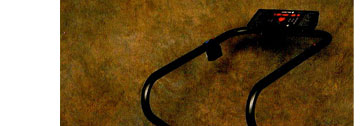
However, The Stone
Clinic recently acquired a treadmill. This one is a breed
apart, the low-impact Orbiter, which offers all the
features of a conventional treadmill, but is designed to
alleviate trauma to joints, knees, ankles, hips, and
back. The key is Orbiter's unique suspended running
surface that absorbs the shock which would otherwise
travel up through the user's foot as his/her heel strikes
the moving platen.
"Orbiter allows us to
exercise our patients on a treadmill without damaging
their joints, and this has had the effect of speeding up
the rehabilitation process tremendously," says Kevin
Stone, MD, orthopedic surgeon and Stone Clinic founder.
Stone, who, as a physician for the United States Ski Team
and the U.S. Pro Tour sees a large number of ski-related
injuries including torn meniscus cartilage, damaged
articular cartilage, dislocated shoulders, and torn
rotator cuffs, says he has found several valuable uses
for his Orbiter treadmill. First is gait
training.
"Many of out patients
who undergo articular cartilage replacement techniques,"
he says, "are obliged to use crutches for four weeks
after the procedure. The most rapidly growing aspect of
the clinic is our articular cartilage transplantation
work, which reflects the sheer number of people whose
chronic injury has led to the development of arthritis.
As the demand for replacing and regenerating joint
surfaces with biological materials rather than artificial
materials grows, so does the demand for low and non
impact exercise.
"The process of
starting these patients back to walking with normal gait
on a normal hard surface typically took 2 or 3 weeks.
However, by putting them on the Orbiter, they were able
to walk with normal gait within the first day or two of
training."
Another Stone
Clinic use for the Orbiter is low-impact running.
Marathoners and track athletes recovering from knee,
ankle, or hip surgery are able to run pain free within
four to six weeks following surgery by exercising on
the Orbiter treadmill.
"Prior to acquiring
our Orbiter, it normally took 8 to 12 weeks to get the
athlete to that point in recovery," Stone
says.
The Orbiter
also proves valuable for cardiovascular training at
The Stone Clinic.
"Studies have
demonstrated that the single most effective
cardiovascular training exercise is uphill walking,"
Stone says. "It's low-impact on the joint, and
high-stress on the cardiovascular system. The Orbiter
accommodates such exercise because its platform can be
elevated to about 20 degrees, creating an uphill effect.
The Orbiter also has a reverse feature, which we use for
downhill and gait training, and as a diagnostic tool in
cases where patients complain of knee pain that manifests
itself only when they go downhill," Stone
says.
Stone first
learned of the Orbiter when a patient brought it to
his attention. The patient - formerly the president
and general manager of Squaw Valley, California ski
resort and recovering from the latest in a long line
of knee surgeries - had been introduced to the Orbiter
by a representative of the Texas company. "My knee
problems were so severe that I could barely walk
across hard pavement without experiencing pain, and
running was absolutely out of the question," says the
patient, Jim Mott. "The people from Orbiter asked me
to see what I thought of their treadmill. I got on one
and was able to run on it for a half hour nonstop
without pain. I couldn't believe it."
"Whatever the nature
of the case, if a treadmill is appropriate for therapy,
then it should be a low-impact device such as this one,"
Stone says. The Orbiter is something that can be at home
in a wide range of practices. It's the treadmill for the
21st Century."